Physicians across America are navigating conversations around peptide therapies—and regulatory frameworks are still evolving. Nearly half (48%) of physicians in Sermo’s latest Barometer reported that patients have disclosed using non-FDA-approved peptides in the past 12 months.
Patients are beginning to arrive with questions about therapies that are often discussed or marketed for uses that fall outside of FDA-approved indications, curious about claims they heard on social media. Doctors are left to field these conversations, largely without clinical guidance or regulatory guardrails to draw from.
34% of respondents in Sermo’s Barometer 45 survey report that their patients have asked about peptide therapies at least occasionally in the past three months. A further 23% said it happens more frequently. Those figures, while already a telling indicator of patient demand, may not even include the patients who are already self-administering compounds without telling their physician.
The Sermo Barometer survey — which included 507 U.S.-based doctors across cardiology, dermatology, endocrinology, internal medicine, neurology, and orthopedic surgery — highlights a concern among physicians: that patient-driven adoption has already outpaced both clinical consensus and regulatory infrastructure. The key concern is that online misinformation is influencing patients faster than evidence-based medicine can respond.
The U.S. Food and Drug Administration (FDA) has scheduled an advisory committee meeting in July 2026 to discuss regulatory considerations such as whether pharmacies should once again be permitted to compound certain peptide-based therapies. The outcome could have implications for how these treatments are accessed and monitored going forward, with speculation pointing toward loosening existing restrictions that were set in place in 2023.
Policymakers are being asked to make consequential regulatory decisions, while some emerging therapies show promise but have scarce human safety data. Pharmaceutical and biotech companies are watching patient demand front-run approval cycles in ways that create both opportunity and reputational risk. Physicians are fielding increased questions about therapies (some more proven than others), and some patients have turned to a gray market, introducing additional safety risks. The Barometer results capture physicians’ concerns amid these ongoing developments.
Key Takeaways
- Physicians are encountering emerging peptide therapies in clinical conversations before formal guidelines, evidence consensus, or regulatory clarity are in place.
- 81% of Barometer respondents say a clear FDA approval or review pathway is essential or very important to how they counsel patients.
- Physicians are not the primary gatekeepers of access. Med Spas, “Research use” online products, and compounding pharmacies are the top 3 reported access channels.
- Patients are arriving with pre-formed, often overly optimistic expectations, shaped by non-clinical information environments such as social media.
- 90% of physicians report concern about patients self-directing peptide use without oversight.
Explore unique insights from physicians on Sermo.
Patients are already using peptides. Physicians are often the last to know.
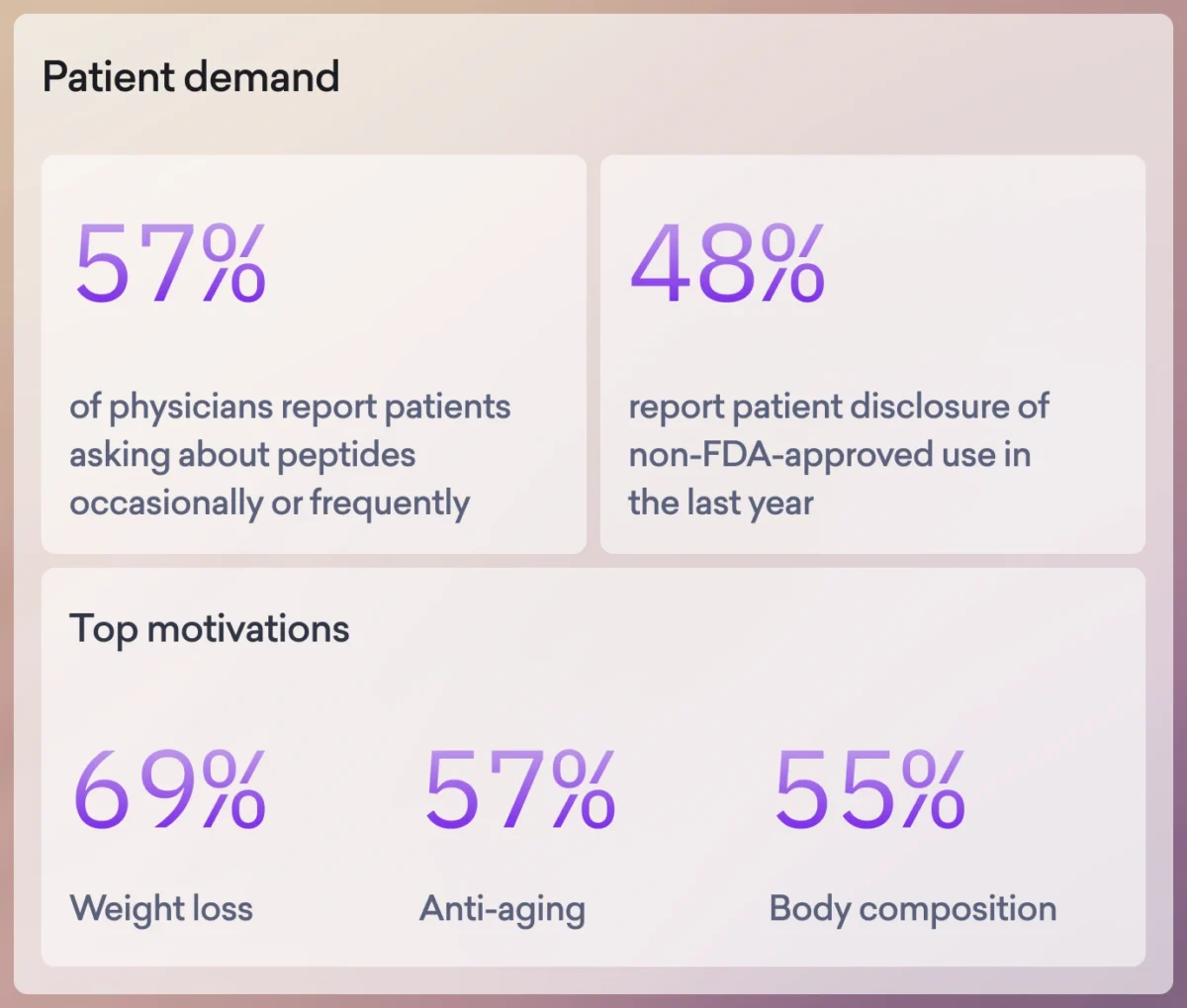
Nearly half (48%) of the physicians surveyed said they’ve had a patient voluntarily disclose use of a non-FDA-approved peptide therapy in the past year. It may be that an even larger volume of patients are using the therapies without disclosing it to their doctors. Patients sourcing compounds from online retailers, med spas or overseas suppliers have limited incentive to raise the subject with their doctor, and may not perceive what they are taking as a medical concern at all.
Barometer respondents find that patients most commonly access peptides through med spas (55%), online retailers selling products labeled “for research” (45%) or compounding pharmacies (43%) (note: respondents could choose more than one answer.) This leaves physicians sometimes needing to step up to manage downstream issues from medications they didn’t prescribe.
Recent reports warn that buying peptides on the gray market or black market (using treatments manufactured legally outside their intended use, or buying products through illegal channels, respectively) is becoming increasingly common.
Weight loss (69%), body composition (55%), anti-aging (57%), longevity (41%) and injury recovery (36%), are the dominant drivers of demand according to the Barometer participants (note: respondents could select more than one answer). For pharma and biotech companies, these patient-reported motivations reveal what patients are actually seeking from peptide therapies, even in areas where formal indications don’t yet exist.
Some peptides have more robust research backing their benefits than others. For example, multiple GLP-1s have received FDA approval, meaning they’ve gone through extensive clinical trials reviewing safety and quality. On the other hand, certain less-proven peptides are growing in popularity thanks to social media, according to a recent review. The authors highlight BPC-157, writing its “clinical validation in human subjects is virtually non-existent,” and GHK-Cu, stating that injecting it could expose joint tissues to excess copper, impairing cell function. Safety concerns have yet to be fully studied in clinical settings.
Barometer respondents report that patients are forming conclusions about peptides before they even set foot in a clinic. One in five physicians reports that peptide conversations (particularly around weight loss and recovery) are shaping patient expectations around outcomes. Patients arrive with preconceived notions about what a peptide can do for them and how long it will take, drawing from information they found online. When physicians counsel caution or decline to prescribe, they may be contesting a narrative the patient has been absorbing for months.
One in 5 physicians say peptide conversations shape patient expectations
Even when physicians counsel against unregulated peptide use, a patient may decide to use the therapy anyway—and not report it. This leaves clinicians without a complete picture of their patient’s full exposure history, a safety concern particularly for compounds with unknown interaction profiles.
Some patients are self-experimenting with peptides, and health systems don’t have a systematic mechanism to track outcomes or intervene. Multiple barometer respondents expressed that they wish above all that patients better understood that some peptides are still unproven. “There is not enough evidence (ie, controlled trials) to back safety and efficacy,” one respondent writes.
Compounding pharmacies, telehealth, and ‘research’ vendors: the unregulated supply chain
When patients report using peptide therapies that are not FDA-approved for their intended use, what access routes do they describe as the source?
Med spas and wellness clinics
Med spas are among the most commonly cited sources of patient peptide access, operating at the intersection of aesthetic medicine and performance optimization. The oversight framework in this space varies considerably by state, and is generally less rigorous than that applied to physician offices.
Med spas usually follow a cash-pay model. Patients with disposable income have greater access to these therapies, but they also bear the risks of unmonitored use at greater scale, while lower-income patients may turn to even less regulated online sources where product quality is entirely unknown.
Telehealth platforms, compounding pharmacies and online vendors all operate under less strict regulations compared to traditional settings. This could compromise patient safety, as indicated by existing warnings about unapproved compounds.
A report from the American Medical Association (AMA) called for stronger regulation and enforcement of med spas overall. Research suggests that physicians in traditional settings often end up managing complications from procedures performed elsewhere in a med spa setting, putting greater strain on physicians and the healthcare system. The report cited a 2020 survey finding that 61% to 100% of complications from cosmetic procedures that dermatologists addressed originated from procedures in medical spa settings.
Compounding pharmacies
Compounding pharmacies represent one of the primary pipelines through which patients access peptide therapies, particularly GLP-based metabolic compounds. The compounding pathway is legitimate; it exists to serve patients with documented needs that commercially available drugs cannot meet. However, quality control obligations for compounding pharmacies are less strict than those governing FDA-approved drug manufacturers. The FDA reported that GLP-1 therapies from compounding pharmacies sometimes contain additional ingredients not found in FDA-approved versions, which may change the efficacy and safety of the treatment.
Telehealth clinics
Virtual prescribers can provide peptides, such as growth hormone secretagogues (GHS) and metabolic compounds. The telehealth model creates a prescribing pathway with minimal friction: patients complete brief questionnaires, consult remotely with a clinician they may never see again and receive prescriptions that feed back into the compounding pharmacy pipeline. Critics of telehealth argue that it often lacks continuity of care compared to in-person care, and that virtual practitioners often diagnose without the benefit of a complete patient history and in-person examination. Telehealth platforms operating in this space are doing so without clear prescribing standards for unapproved compounds.
Online vendors
Some patients turn to a gray market of compounds sold explicitly as “research use only” products — a legal designation designed for laboratory use that has become a commercial loophole. Patients are self-administering these compounds with no physician involvement and no quality assurance. With the vendors operating largely outside the reach of enforcement mechanisms, the FDA has warned Americans not to purchase the products. Physicians are also wary, with 90% of Barometer respondents reporting some level of concern about patients self-directing peptide use without medical oversight.
90% of Barometer respondents report concerns about self-directed peptide use
The misinformation ecosystem: How patients are forming their peptide beliefs
More than half of physicians surveyed report that when patients arrive with questions about peptide therapies, they usually cite social media content, podcasts or online forums as their primary source of information. This tracks with ongoing research. For example, one recent study analyzed Reddit subforums dedicated to therapeutic peptides, finding that users often sought dosing regimen and “self-experiment” advice, expressing distrust in traditional healthcare.

Patients may listen to a longevity podcast featuring a prominent physician or researcher who discusses the theoretical benefits of a peptide compound. The content is clipped and amplified on social platforms. Fitness influencers incorporate it into their content with anecdotal claims about personal results. Online vendors begin marketing the compound directly to consumers, embedding testimonials and before-and-after imagery. By the time a patient raises the subject with their physician, they may have been exposed to this information environment for months, and their expectations have been calibrated accordingly.
Physicians are left to manage those expectations, which may or may not be realistic. Barometer respondents believe unrealistic expectations (33%), a pressure to recommend non-approved treatments (21%) and safety misconceptions (20%) are the main clinical challenges surrounding peptide treatments. “There’s a lot that’s still being studied regarding the new peptide therapies, and patients are getting very one-sided information — mostly positive — online through social media and influencers without the appropriate medical background,” one respondent writes.
What is the biggest challenge peptide-related conversations create in clinical practice?
Barometer results suggest that misinformation is shaping patient expectations and increasing the clinical burden on physicians. Many patients are forming treatment expectations before they ever speak with a healthcare professional. When physicians spend valuable visit time correcting misconceptions, it places additional demands on clinicians already navigating evolving regulations.
CME providers, professional societies and medical affairs teams can intervene earlier. Better physician education can help clinicians respond consistently to patient questions, while accessible patient-facing resources can counter misinformation before it reaches the exam room.
FDA regulation and what comes next
Sermo’s Barometer 45 data provides frontline physician sentiment in the lead-up to the FDA’s scheduled July 2026 advisory committee meeting on peptide regulations.
81% of physicians consider a clear FDA approval or review pathway highly important to how they counsel patients. They demand clarity on which compounds are approved, for what indications, at what dosing, and with what known risk profiles.
Respondents expressed that their top concern (33%) if access to peptide therapies expands is that patients will self-direct treatment without medical oversight, followed by being able to monitor the safety and side effects.
If access to certain peptides were expanded, what would be your biggest concern in clinical practice?
There is nuance in what “expanding access” might mean in practice. A regulatory framework that legitimizes some peptide therapies could, if poorly designed, muddy the landscape further — making it even harder for patients to distinguish regulated from unregulated products in a market that will continue to grow regardless of what the FDA does.
The FDA’s July 2026 advisory meeting could define the commercial and clinical landscape for peptide therapies for years ahead. Pharmaceutical companies, payers and health systems will have to adapt to whatever regulatory framework emerges.
Retatrutide and other triple-agonist therapies are already on patients’ radars
The pattern of patient demand front-running clinical guidance and regulatory infrastructure is already reproducing itself with the next generation of GLP-based therapies. Among cardiologists, endocrinologists and internists surveyed, nearly one quarter report that patients are already asking about triple-agonist therapies (informally known as “GLP-3s”) like retatrutide, a compound still in Phase III trials. This also represents the category of peptides that Barometer participants feel they know the most about, with 27% feeling “very familiar” and 31% “somewhat familiar” with weight, metabolic and cardiometabolic peptides.
69% of respondents believe their patients will be eager to try triple-agonist therapies or are already asking about them.
GLP-3 therapies are entering a landscape already distorted by GLP-1 and GLP-2 hype from social media. This time around, pharmaceutical companies developing next-generation GLP-based therapies can engage with physicians sooner: not just after approval, when gray markets are already established. Professional societies in cardiology, endocrinology and internal medicine can develop specialty-specific clinical frameworks ahead of approval.
Pharmaceutical companies and health systems can prioritize proactive clinical engagement and clear regulatory timelines, so that this time, the industry is positioned to manage them. Overall, the Barometer results show that patients are expressing interest in emerging peptide therapies, and that physicians need clear approval practices amid their rollout.
Guidance, oversight, and education: Physicians know what they need from health systems
Multiple players in the healthcare system could help solve challenges around peptide therapies. Based on Sermo’s Barometer 45 results, physicians believe the following could be most effective in improving the peptide landscape:
Clinical guidance
Respondents on Sermo want evidence-based, specialty-specific frameworks for counseling patients on peptide therapies. Physicians report a lack of standardized guidance on how to monitor patients already using peptide therapies, including uncertainty around safety, interactions, and expected outcomes.
- What monitoring is appropriate if a patient is already using a compound?
- What interactions are known or plausibly concerning?
- What outcome claims have any evidentiary basis, and which are purely anecdotal?
Without frameworks, physicians must improvise in every patient conversation. It is now up to professional societies and pharma medical affairs teams to develop and disseminate this guidance.
Regulatory oversight
When 81% of physicians say a clear FDA approval or review pathway is very important to how they counsel patients, they’re seeking the ability to have informed, evidence-grounded clinical conversations. The 90% of physicians who report concern about patients self-directing peptide use without oversight want a regulatory environment in which access is connected to oversight.
Patient and provider education
Barometer respondents confirm that misinformation from social media is widespread. Patient education that can compete with influencer content on reach, accessibility, and emotional engagement could help counteract myths. Pharma, professional societies, digital health platforms and patient advocacy groups can all have a hand in educating patients. Simultaneously, CME providers can better equip front-line physicians with accurate information.
Physicians have major concerns — but also envision solutions
Sermo’s Barometer 45 captures a healthcare system in the middle of a transition it did not plan for. Peptide therapies have moved from fringe wellness culture into the mainstream, with emerging gray and black markets creating safety issues. Physicians surveyed on Sermo are already observing the effects within their day-to-day practices, and their overall outlook is one of concern. This places physician sentiment at a critical moment in U.S. regulatory decision-making, where policy may shape how these therapies evolve in clinical practice.
In the lead-up to the FDA’s July 2026 advisory committee meeting, physicians are indicating that they’re in favor of regulatory oversight, including a clear FDA approval or review pathway. The Barometer data offers a unique glimpse at how physicians on the front lines view existing challenges and potential solutions. Pharmaceutical companies and health systems watching patient demand build for next-generation GLP-based therapies can act proactively to prevent gray markets. Patient interest in peptide therapies is clearly accelerating. What happens next will depend on whether evidence, education and regulation can catch up.
Methodology
This survey was fielded May 8–13, 2026 as part of Sermo’s ongoing Barometer study. The sample included 507 U.S. physicians across the following specialties: Cardiology, Dermatology, Endocrinology, Internal Medicine, Neurology, and Orthopaedic Surgery.
Explore the full Barometer 45 findings for deeper insights into how physicians are handling the growing demand for emerging peptide therapies among regulatory uncertainty.