Despite rising investment in women’s health, healthcare professionals say delayed diagnosis, limited access and uneven treatment options still define care for many patients.
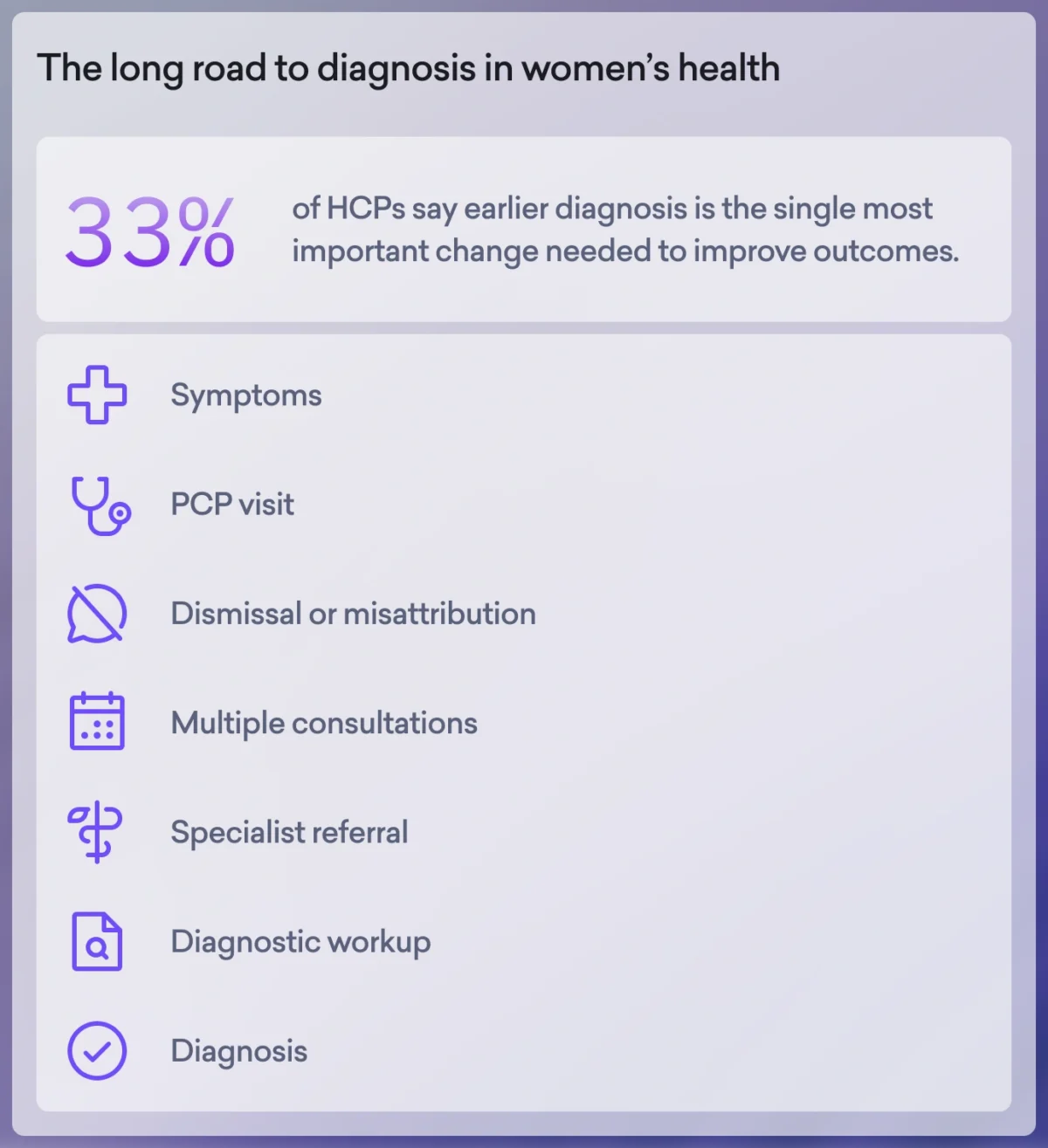
87% of those polled in Sermo’s Barometer 44 survey of more than 800 HCPs who treat women’s health conditions said they’ve noticed at least some progress in women’s healthcare over the past five years. Still, they acknowledge room for improvement; 33% consider earlier diagnosis as the single most important factor that could improve women’s health outcomes overall. The areas physicians say most urgently need therapeutic innovation; menopause, fertility and endometriosis; are also the areas where diagnostic limitations continue to delay care.
Key Takeaways
One in three (33%) healthcare professionals say earlier diagnosis is the key to improving women’s health outcomes.
Less than half (39%) of providers feel very confident managing menopause symptoms, and demand for DTC services is outpacing traditional care settings.
78% of providers report that their patients regularly ask for fertility supplements seen online, despite little to no clinical impact.
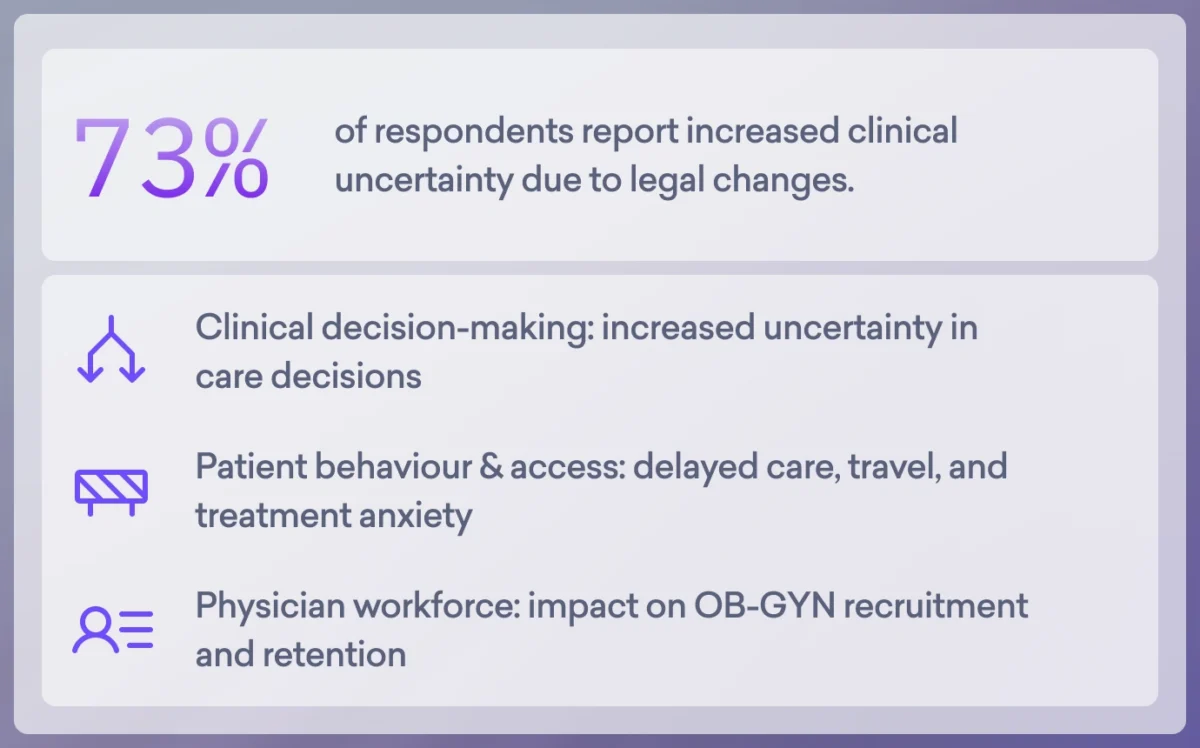
89% of respondents identify that reproductive health laws and policy changes lead to delayed care, increased travel, and heightened anxiety for patients.
Earlier diagnosis, better diagnostic tools and improved patient and provider education represent the three core areas of improvement needed.
Discover unique insights from Sermo’s community of 1.5M+ healthcare professionals.
The consensus: therapeutic advances (like new hormonal and non‑hormonal agents, IVF protocols and menopause‑specific therapies) are outpacing the tools that help diagnose conditions early. Adding to the issue, some symptoms of endometriosis, PCOS or early menopause have historically been dismissed as “stress” or “lifestyle,” likewise leading to later diagnoses. Patients who spend years seeking answers for chronic pelvic pain, irregular menstrual cycles or unexplained infertility may begin to feel dismissed or disbelieved, potentially making them less likely to seek follow-up care in the future.
Adding to diagnostic delays, most women first present to general practitioners or internists, who may lack the training or tools to screen effectively. Endometriosis, for instance, typically requires laparoscopic confirmation or advanced imaging that isn’t standard in a general practitioner encounter.
“What the Sermo Barometer captures is what I see everyday in my practice: the menopause patient who is dismissed by her gynecologist because they don’t ‘believe in hormones,’ the couple with infertility who is losing hope due to failed IVF cycles and poor insurance coverage, and the endometriosis patient who was undiagnosed for years due to lack of non-invasive testing,” says Sara Farag, MD, FACOG, board certified physician in Obstetrics & Gynecology and Sermo medical advisory board member. “Women’s health has made genuine strides, but the common thread running through every one of these scenarios is that we are still struggling to properly treat these conditions.”
Each of these scenarios has direct impacts on patients. For example, endometriosis often takes years to diagnose, leading to longer dealings with pain and irreversible damage. Many women go through multiple consultations (and often multiple physicians) before receiving a PCOS diagnosis, and earlier diagnoses could reduce the progression of comorbidities (like diabetes and hypertension) and recourse to fertility treatments. Research finds that it often takes more than three years for women to receive an infertility diagnosis, and delays can reduce the impact of treatments due to age-related declines in fertility.
Over the last decade, investors have funneled billions into women’s health innovation, spurring treatment breakthroughs. Investment in women’s health reportedly more than tripled from 2020–2025, reaching a new high of $2.6 billion in 2024. However, Sermo members believe menopause care, endometriosis and fertility treatments are the areas of women’s health that are still in greatest need of R&D investment.
This article will further explore why new technologies often don’t reach female patients fast enough, and the implications for patients, physicians and the healthcare industry.
The access gap: why women seek care outside traditional settings
Physicians on Sermo say innovation alone isn’t solving the day-to-day barriers patients face when it comes to access. When the path through the formal healthcare system is long and expensive, patients often look elsewhere. Gaps in access, coverage and affordability are driving greater use of med spas and direct-to-consumer (DTC) services. Women account for more than three-quarters of med spa patrons, and are the most commonly targeted demographic of DTC services, according to recent reports.
These settings offer convenience, but may operate under different—sometimes less stringent—regulatory structures and levels of clinical oversight than traditional care. Some groups have advocated for heavier regulation of med spas as a way to improve care. For example the American Medical Association (AMA) issued a brief calling for increased physician supervision at med spas, arguing that “a lack of regulation and enforcement has enabled a large number of inadequately trained or unsupervised practitioners to provide cosmetic medical procedures in medical spas to an unsuspecting public.”
Even with stricter regulations, a shift to boutique and concierge clinics could make care less accessible to those who can’t afford retainer fees. In some cases, women without disposable income could decide to delay care, rely on social media for medical guidance or even go without. Digital health platforms and telemedicine services have attempted to close some of these access gaps, particularly for menopause and reproductive health counseling. However, critics argue that convenience alone does not guarantee continuity of care, especially for patients with complex medical histories or conditions requiring imaging, laboratory testing or multidisciplinary management.
A shortage of OB-GYN specialists is also impacting women’s healthcare. One study estimates that from 2025 to 2037, the demand for OB-GYNs in the U.S. will increase by 2.7%, while the supply will decrease by 10.3%. Primary care physicians often deliver services traditionally offered by OB-GYNs, with women in rural areas or with a low socioeconomic status more likely to seek OBGYN services from family medicine physicians or internists.
In the Sermo Barometer, expanded access and coverage ranked as one of the top changes that members believe would best improve women’s health outcomes (23%). As for the role they think healthcare companies could support them, they point to measures like improving affordability and access programs (25%), investing in earlier diagnostic tools (24%) and providing stronger clinical education (14%).
What is the most valuable way pharmaceutical, medical device and healthcare companies can support physicians in advancing women's health?
Improve affordability and access programs
25%
Invest in earlier diagnostic tools
24%
Develop more targeted therapies
23%
Provide stronger clinical education
14%
Fund real-world evidence and research
8%
Offer patient education resources
6%
Other (please specify)
0%
n = 812
The latter highlights the role that medical education companies, CME providers and medical affairs teams can play in improving women’s healthcare. Medical education has historically failed to fully shed light on women’s health outcomes, due to a lack of female subjects in clinical trials and fewer studies on female-specific conditions, the authors of a 2025 study noted.
In many ways, the access gap and the education gap reflect the same underlying issue: patients cannot receive effective care if frontline clinicians lack the tools, training, or time to confidently diagnose and manage women’s health conditions early.
Menopause care: lingering unmet needs
By 2030, an estimated 1.2 billion women will be menopausal or post-menopausal, with the treatment market projected to hit $24.35 billion. Despite record investment, recent FDA approvals and heightened celebrity attention, only 21% of surveyed Sermo members believe current menopause treatment options meet their patients’ needs very well.
Insight
Only 1 in 5 Sermo Barometer respondents believe their menopause patients’ needs are being met very well.
Many of the respondents (40%) view non‑hormonal therapies (e.g., selective serotonin‑reuptake modulators, non‑hormonal vaginal options) as complements to, but not replacements for, hormone replacement therapy (HRT). While clinical guidelines outline hormonal and non-hormonal options, there is no single standardized algorithm for managing patients with overlapping vasomotor, mood, and sexual symptoms; major societies emphasize that treatment should be individualized based on symptom burden, risk profile and patient preference.
Survey respondents point to several barriers standing in the way of better menopause care:
What is the biggest barrier to optimal menopause care?
Lack of provider education
23%
Patient misconceptions/stigma
20%
Limited treatment options
17%
Lack of patient education
17%
Insurance/access issues
9%
Lack of patients initiating discussion
8%
Time contraints during visits
7%
n = 812
HCP education gaps
Only 39% of respondents feel “very confident” managing menopause. Menopause receives limited attention in medical training, leaving CME providers and pharma medical affairs teams to educate physicians.
Confusion around menopause management has also been shaped by shifting guidance following the Women’s Health Initiative (WHI) study in the early 2000s, which linked hormone therapy to elevated health risks and led to a decline in prescribing. Subsequent re-analyses and updated guidance from organizations like the American College of Obstetricians and Gynecologists (ACOG) have emphasized that risk profiles differ substantially depending on patient age, timing of treatment initiation and formulation, leaving many clinicians navigating years of evolving recommendations.
The result is a menopause care landscape in which patients may receive dramatically different recommendations depending on the clinician they see. This inconsistency could contribute to confusion around the risks and benefits of hormone therapy, particularly among women navigating symptoms that affect sleep, cognition, mood and sexual health simultaneously. As public discussion around menopause grows, physicians, CME providers and medical societies face increasing pressure to translate evolving evidence into clearer, more practical guidance for frontline clinicians (and their patients).
Patient stigma
Patients sometimes dismiss symptoms like hot flashes and vaginal changes as “just getting older,” or are embarrassed and avoid seeking care, contributing to undertreatment, one study notes. Herein lies the opportunity for physicians, patient advocacy groups and DTC companies to work to reduce the social stigma around menopause.
Insurance/access issues
9% of Sermo Barometer respondents believe lack of access is the main barrier standing in the way of optimal menopause care. While some argue that DTC and cash-pay services (e.g., boutique menopause clinics) have the potential to expand access and lower costs, others caution that the out-of-pocket expenses associated with some DTC products could hinder access to care for some patients.
Fertility care: concerns about commercialization
Fertility care is advancing rapidly, with 82% of Barometer survey respondents noting progress compared to five years ago. 89% of the respondents want stronger regulation.
Many are skeptical of newer developments; 65% of the respondents said emerging ovarian “rejuvenation techniques” aimed at improving IVF success are “promising but still experimental” or “largely unproven.”
How would you describe your view of emerging ovarian "rejuvenation" techniques aimed at improving IVF success (e.g., PRP, experimental biologic approaches)?
Promising and evidence-based
14%
Promising but still experimental
49%
Largely unproven
16%
Concerning due to limited data
5%
Not familiar
17%
n = 812
These treatments include the administration of stem cells and growth factors in hopes of promoting proper ovarian function. Critics have pointed specifically to IVF “add-ons” such as platelet-rich plasma (PRP), expanded fertility testing panels and wellness-oriented supplements that may be marketed without standardized outcome reporting. On social media, clinics may post content suggesting some treatments are universally effective when that’s not the case, giving patients unrealistic expectations, according to the American Society for Reproductive Medicine (ASRM).
Insight
80% of respondents express concern about fertility clinics adopting a more consumer-driven medspa-like model.
Critics of the shift have argued that these clinics sometimes fail to meet scientific standards and that they give patients a sense of false hope. Some have called for stricter regulations around advertising; for example the authors of one study argued that the U.S. Food & Drug Administration (FDA) and Federal Trade Commission (FTC) could create egg donation advertisement regulations to prevent overly persuasive ads.
Existing oversight is also fragmented. While professional groups such the Society for Assisted Reproductive Technology (SART) publish advertising and reporting guidelines, adherence varies across clinics, and researchers have found inconsistent compliance with standards around success-rate reporting and disclosure of experimental procedures.
Healthcare professionals would like to see increased patient awareness around over-the-counter vitamins and supplements. 38% believe supplements can have minimal impact on fertility outcomes, and 78% said patients ask them about the supplements frequently or on occasion.
In recent years, the FDA issued warning letters to companies selling fertility supplements with unsupported claims. Industry observers argue that clearer guardrails around advertising, pricing transparency and the use of investigational procedures would not stifle innovation, but instead help reputable fertility clinics, diagnostic developers and medical device companies compete on clinical quality. Stronger standards could also theoretically increase patient trust in the assisted reproductive technology (ART) sector and create more consistent expectations for providers operating in a rapidly commercializing market.
Overall, polled Sermo members are in favor of better patient education in the fertility space, so that patients are better informed about the effectiveness of these treatments. The gap between patient demand and clinical evidence represents both a challenge for physicians and an opportunity for companies that can bring the two closer together.
Policy shifts in U.S. reproductive health
Insight
83% of Barometer respondents said recent legal shifts have affected their practice to some extent.
These policy changes can affect physicians’ approaches to ectopic pregnancy management, miscarriage care, documentation practices and referral patterns.
In the U.S., state-level abortion laws and changes to IVF coverage are affecting triage decisions for ectopic pregnancies, miscarriage care, high-risk pregnancies and documentation habits. For example, more than one hundred pregnant women in medical distress have been turned away or treated negligently since 2022, an analysis from the Associated Press (AP) found.
IVF coverage in the U.S. remains subject to state-level mandates and employer-sponsored insurance. While some states have expanded requirements for insurers to cover fertility treatment, these policies often exclude small employers and do not apply to many self-insured plans. In the wake of Dobbs v. Jackson Women’s Health Organization, additional legal uncertainty around embryo status in some states has further complicated access, prompting some clinics to pause services.
Meanwhile, some patients are forced into cross-state travel, which others cannot afford at all. This can create a higher burden on providers in states with more permissive laws.
Legal uncertainty surrounding reproductive care may cause some patients to delay seeking treatment until symptoms become severe. Emergency care disputes involving miscarriage management and ectopic pregnancy treatment have heightened anxiety around when and where patients can safely access care, potentially increasing emergency department utilization and worsening outcomes for some women.
At the same time many physicians are under strain in areas with a shortage of OB-GYN specialists. One study projected a shortage of OB-GYNs in all but six states by 2035.
Workforce strain is being compounded by high burnout rates, liability concerns and growing operational pressures within obstetrics and gynecology. The ACOG has warned that burnout, stress around malpractice exposure and staffing shortages are contributing to physician attrition and reduced clinical capacity, particularly in rural and underserved regions. Some practices have responded by limiting high-risk obstetric care, surgical services or fertility offerings, further narrowing access for vulnerable patients.
The solutions that could improve women’s healthcare
“Women’s health has made genuine strides, but the common thread running through every one of these scenarios is that we are still struggling to properly treat these conditions. Earlier diagnosis, better diagnostic tools and stronger education for both providers and patients. This is the trifecta this field needs.”
Dr. Farag, MD, FACOG
A few themes emerge from Sermo’s Barometer 44 data.
The benefits of earlier diagnosis are straightforward. For example, the authors of one study found that endometriosis has an average diagnostic delay of 6.8 years, and noted that faster diagnoses could reduce patients’ pain, the severity of their conditions and the development of comorbidities.
Better diagnostic tools could also change women’s healthcare for the better. The industry could benefit from non-invasive, accessible tests that can be seamlessly integrated into routine primary care workflows. Examples include non-invasive biomarker panels for endometriosis detection, AI-assisted imaging interpretation, wearable biomonitoring tools and point-of-care hormone testing that could help primary care clinicians identify reproductive and hormonal disorders earlier without relying exclusively on specialist referral pathways.
The survey also highlights a desire among healthcare professionals for stronger education, especially in the realm of menopause care. For patients, this could lead to better public literacy regarding normal versus abnormal symptom patterns and realistic expectations regarding fertility and menopause. One study investigated the most common misconceptions about female reproductive health that spread online, finding that one-third of the content misattributed risks to evidence-based interventions.
For physicians, better education requires standardized, up-to-date training in reproductive aging, PCOS and menopause so that primary care clinicians feel confident initiating triage and management.
Explore Sermo Barometer Research
The Barometer 44 findings capture women’s healthcare at an inflection point: enough progress to sustain optimism, yet enough persistent gaps in diagnosis, access and education to demand urgency. Billions of dollars in investment have expanded treatment possibilities, but many physicians say the fundamentals of care (early diagnosis, equitable access and evidence-based patient education) still lag behind. Many physicians believe women’s health has made strides, while still often failing patients.
Methodology
This survey was fielded from 20 Feb – 3 Mar 2026 and included 812 global healthcare professionals who treated women’s health conditions and whose specialties included OB-GYN, general practice, internal medicine, nurse practitioners, and physician assistants.
Explore the full Barometer 44 findings for deeper insights into how clinicians view these shifts and the solutions they’re suggesting for better patient outcomes.
Wait — aren’t you a little curious?
Stay ahead with The Sermo Roundup — your weekly dose of peer insights, practical guides, and trends shaping the medical profession.