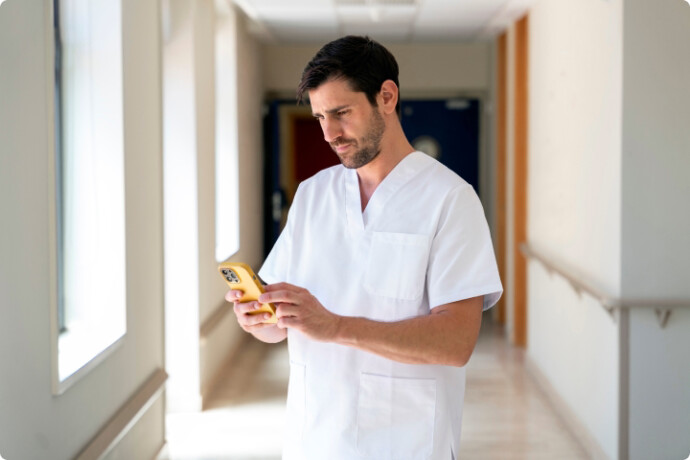
It’s a common enough sight: a nurse in scrubs grabbing a coffee before a shift, or picking up groceries on the way home. It may seem harmless, just a matter of convenience in a tightly packed schedule, but it raises concerns about contamination and infection control.
Research indicates that pathogens like Methicillin-resistant Staphylococcus aureus (MRSA) and Vancomycin-resistant Enterococci (VRE) can survive on polyester-cotton blends—which commonly make up scrubs—for days under laboratory conditions.
When you wear scrubs into a grocery store or onto public transit after a shift, you are potentially introducing hospital-acquired pathogens into the public sphere. Conversely, the street is not sterile. Bringing community allergens, pet dander and external bacteria into controlled clinical environments or an immunocompromised patient’s room compromises safety.
Issues can also arise around laundering your scrubs at home rather than at work. Guidelines for healthcare textiles often reference thermal disinfection temperatures around 160°F (71°C) for sustained periods. Most home washing machines do not consistently reach or maintain these temperatures, which can make effective decontamination more variable.
As Hospital-Acquired Infections (HAIs) increasingly impact reimbursement rates and hospital safety ratings, the responsibility for uniform hygiene is shifting. It’s moving away from being a matter of “personal choice” to becoming a critical component of institutional infection control.
This article dives into the risks and the protocols that can keep you and your patients safe.
The risks of traveling in scrubs to and from work
Hospitals are reservoirs for pathogens, which can adhere to uniforms, and fabric choice plays a role. While cotton is breathable and comfortable, it is also absorbent. Many modern scrubs use antimicrobial synthetic blends designed to repel fluids and inhibit bacterial growth. Still, by the end of a shift, the “bacterial load” on a uniform can be significant.
Nurses have discussed the practice of wearing uniforms in public on Sermo, and the consensus leans toward caution. “Our uniform shouldn’t be worn outside the hospital for any reason because of hospital-acquired infections,” writes one nurse. Another warns that”what you wear to the hospital environment increases the spread of infection,” while a third cautions that wearing your uniform outside the workplace “can spread a lot of things.”
Commuting in scrubs vs. changing at work: is it worth it?
The question remains whether public exposure when commuting in scrubs presents an insignificant risk or is a primary driver of HAI transmission. The authors of one 2023 study concluded that textiles can harbor bacteria, but that most of the bacteria in the study are normally found on human skin, so it was impossible to draw conclusions about textile contamination as a source of HAI transmission.
Nurses on Sermo have reflected on this specific dilemma. Some take a hard stance, advising that nurses should change when they get to work. “Yes, wearing uniforms to/from work increases the risk of infection,” an operating room nurse writes. “Everyone should put on their uniforms when they arrive and take them off when they leave,” another member states.
However, other nurses believe commuting in scrubs can be okay, depending on the circumstances. “It depends on whether you go to work in your car,” one writes, arguing that public transit is a different story.
A psychiatric nurse believes the clinical setting matters: “If you work in a place where you hardly come in contact with patients or their surroundings, then it may be safe to wear your uniform to/from work. Other things to consider are the kind of family settings you have. One should be careful in order to protect our babies and elderly loved ones.”
Washing scrubs at home vs professional cleaning
In an ideal world, every hospital would provide hospital-laundered scrubs that you pick up at the start of a shift and drop in a chute at the end. Industrial laundering is the gold standard.
Industrial facilities use precise chemistry and thermal disinfection processes. They wash at high temperatures (often exceeding 160°F) for sustained periods.
Domestic washing machines are built with a different intention. They are designed for energy efficiency and gentle care of consumer fabrics. Even on a standard “hot” cycle, a home machine might only reach 130°F—hot enough to fade your favorite jeans, but perhaps not hot enough to kill a stubborn colony of VRE.
Furthermore, detergent types vary. Industrial laundries use calibrated detergents and bleach concentrations that are formulated to disrupt organic matter and microbial films more consistently. At home, you might use eco-friendly, cold-water detergents that are excellent for the environment but less aggressive against pathogens.
How your scrubs are dried is another factor. Industrial dryers get incredibly hot while home dryers vary. If you air-dry your scrubs (to prevent shrinking, for example), you lose the thermal kill step that a dryer provides.
However, the reality is that many nurses wash their scrubs at home. If you are in this position, you can follow a protocol that aims to bridge the gap between domestic and industrial cleaning.
A science-based protocol for washing scrubs at home
If you are responsible for your own uniform hygiene, treating your laundry like a scientific process may help reduce risk. Here is a scrub laundry protocol designed to maximize safety:
Isolate and contain
The process starts the moment you take your scrubs off. Immediately place used scrubs into a dedicated, washable bag (like a pillowcase or a laundry bag). Never shake your scrubs when taking them off or putting them in the machine. Agitating the fabric may disperse particulate matter into the surrounding environment, spreading pathogens into your home’s air and onto nearby surfaces.
Separate the load
This is non-negotiable. Wash scrubs alone. Never mix clinical attire with household linens, towels or personal clothing. You don’t want the bacteria from your shift migrating onto your bath towels or your other clothing items.
Turn inside out
Before washing, turn your scrubs inside out. This helps prevent pilling and fading and ensures the inner surface—which has had direct contact with your skin—is thoroughly flushed and cleaned.
Max heat wash
Forget the “Eco” setting for this load. Use your machine’s “Sanitize” or “Heavy Duty” setting. You want the water as hot as possible. If your machine has an internal heater, use it. If not, ensure your home water heater is set appropriately (while being mindful of scalding risks at taps).
High-Heat Dry
Sunlight exposure is not a reliable way to disinfect scrubs. Tumble dry on “High” for at least 30 minutes. This provides a vital “thermal kill step” for any bacteria that survived the wash cycle. Ensure the scrubs are completely dry before removing them. Dampness encourages bacterial regrowth.
Store Separately
Once clean, don’t throw your uniform back in with your gym clothes. Store scrubs in a dedicated drawer or area away from your everyday wardrobe. Keep them clean until the moment you bag them up to take to work.
Better hygiene, better outcomes
Commuting in your scrubs and washing them at home can feel more convenient, but it could expose your patients to infection risks. Scrub hygiene is an important tool in the fight against HAIs. By adopting a stricter protocol—changing at work whenever possible and using high-heat washing methods if you do opt for home cleaning—you are protecting your patients, your family and yourself.
On Sermo, members are debating the legitimacy of commuting in scrubs, along with other dilemmas central to nursing. Join to add your voice to the conversation, participate in paid medical surveys and build connections with healthcare professionals around the world.