Having an effective marketing strategy is key to growing your medical practice. After all, the more new patients you have, the more people you can help.
If you’re wondering, “How do I attract new patients and grow my clinic?” you’re not alone. We’ve put together this helpful guide with the tips and best practices you need to get more patients.
How to get more patients to your clinic: 22 ways
Doctors strive to increase patient numbers for several reasons. In a survey of nearly 1,700 doctors, the most common reasons given were:
Helping more people (28%)
Establishing a reputation (27%)
Getting more experience (20%)
Making more money (20%)
Wanting to grow your business and knowing how to get more patients are two entirely different variables, however. Whatever your motivation for expanding your customer base, these patient acquisition methods and clinic advertising ideas will help you retain existing clients, attract new business, and optimize your practice for success.
1. Identify your target audience
Marketing strategies for medical practitioners should be targeted, so defining your audience is the first step to getting more patients into your practice. When you know your target audience, you can make better decisions about the communication channels you use to reach them and the types of content you create to share. Age, gender, profession, and location are usually the first factors.
2. Employ high-quality staff
Your employees are the face of your business, and in the medical sector, experience counts. For the skill set, knowledge, and proficiency of a veteran medical receptionist or medical assistant, it is usually well worth paying a little extra to secure the most qualified and experienced candidates.
3. Invest in employee training
Doctors’ visits can be stressful, and your front-of-house staff is often the first human touchpoint for your patients. Nervous patients, in particular, need warm welcomes and reassurance, so regular customer service training is a must. Employees should also be well trained on products and services, pricing, and the equipment you use so they can answer any questions patients may have.
4. Keep existing patients happy
Providing exceptional experiences and nurturing strong relationships with existing patients helps them stay longer and be more likely to recommend you to friends, family, and colleagues. In our most recent survey, 42% of doctors said that word-of-mouth referrals were most important when considering how to get new patients.
“Listening to patients patiently is the best approach to make them happy. A happy patient comes with new patients.”
Ophthalmology, Cuba
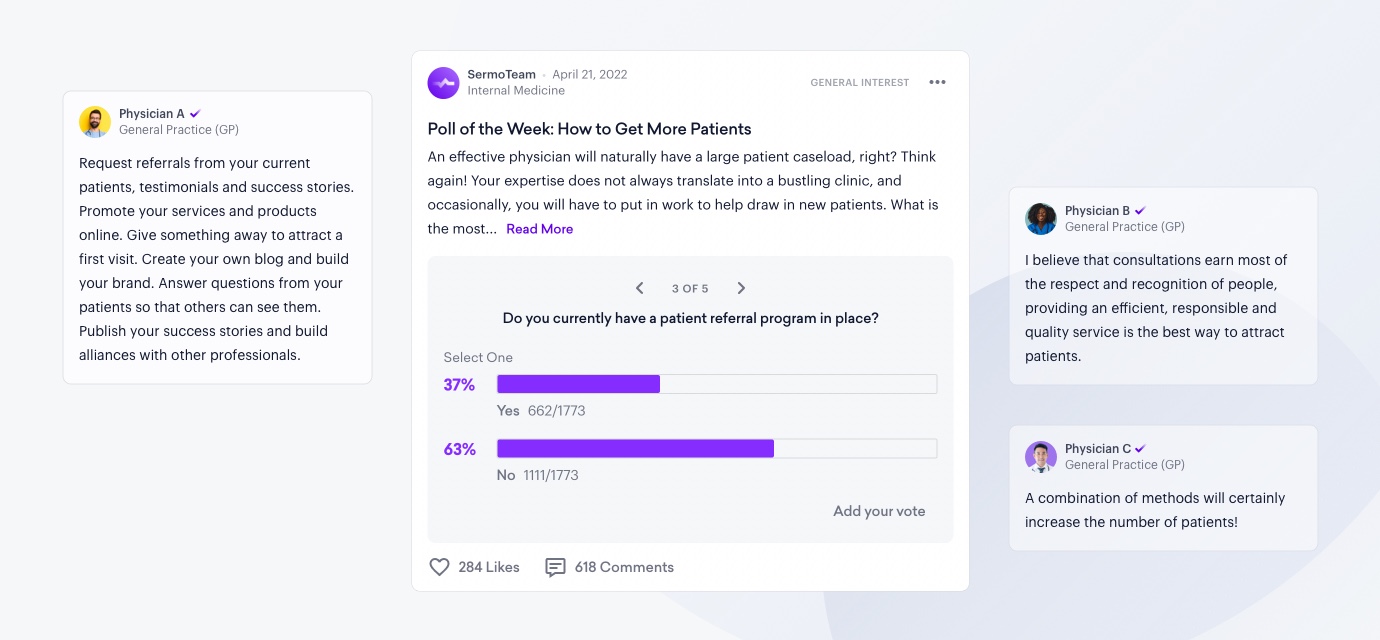
5. Create a patient referral program
Getting referrals from existing patients is one of the cheapest ways to attract more patients. However, our survey revealed that only 38% of practices have a referral program in place – meaning a staggering 62% of clinics are missing out on this invaluable revenue stream. The process behind patient referrals is straightforward. Offer rewards to patients who refer family, friends, and colleagues. Then remind them to refer others after a good experience and welcome new patients from their referrals.
6. Ask for patient reviews
22% of doctors in our survey said patient reviews were the most effective way to get more patients. Yet, only 11% regularly ask for reviews, 39% admitted they never ask for reviews, and 22% said they rarely ask for reviews. Consistent, high-quality experiences will likely earn you some reviews, but you’ll get many more if you ask for them. Curious about how to get patients to submit reviews? You can employ several tactics:
Send follow-up emails requesting a review.
Offer freebies and discounts for patients who leave a review.
Give patients a business card with a ‘review us online’ request.
Share current reviews online (with consent, of course) with a call to action encouraging other patients to share their experiences.
7. Get listed on online directories
Having an online presence on as many sites as possible increases your visibility. The most suitable sites for doctors are:
Claiming your listing is easy and free. Simply fill out your profile as completely as possible, including:
Services available
Contact details
Opening hours
Links to your website
Pictures and Logos
9. Modernize your website
13% of the doctors we surveyed considered their website the most effective tool for patient acquisition. Your website should be up to date, easy to navigate, and visually appealing. From a technical viewpoint, that includes optimizing for mobile viewing, easy navigation, and accessibility. You should also:
Make it visually appealing with warm, welcoming colors.
Include patient reviews.
Add actual photo and video content from the clinic rather than stock photos.
Emphasize your skills and experience by including your most up-to-date qualifications, recognitions, and awards.
10. Invest in SEO improvements
Updating your web copy to include more keywords, improve metadata and alt tags, add internal and external links, and set focus keyphrases for each page will improve your Google ranking. You can also capitalize on local SEO by including location-based long-tail keywords like ‘pediatrician in New York,’ ‘nutritionist in San Francisco’, or ‘cardiologist in Chicago.’ According to our survey, only 3% of doctors classed local SEO as an important factor in getting more patients, which shows scope for improvement across the board.
11. Start a blog
Blogs serve many purposes in the medical field and shouldn’t be underestimated as a way to attract and retain patients. Publishing regular blog posts allows you to:
Showcase your knowledge and expertise
Answer common questions
Share helpful information
Weave in more SEO keywords to get more visitors to the site
Develop a reputation as a leader in your field
More than anything, blog posts give potential patients an insight into who you are as a person, which helps build trust.
“The most effective way is to be oneself, an empathetic person (human) with whom the patient can feel trusted and helped by concentrating on their attention. This attracts patients and they spread the word.”
Radiology, Canada
12. Be active on social media
Social media is a major driver and a medium you can’t afford to exclude from your patient acquisition strategy. 15% of doctors say using social media is the best way to get more patients. It is unsurprising, given that:
41% of patients use social media to decide on their healthcare providers.
“Keeping up to date, being attentive, and having a good social media marketing team is key to attracting more patients.”
Pediatrics, Venezuela
13. Use email marketing
Email marketing lets you send custom, personalized messages that connect with people efficiently and cost-effectively. Only 3% of doctors consider it an important factor in attracting more patients, so physicians who get ahead with email marketing will likely reap significant benefits.
Create a mailing list and send updates with links to your social media accounts, blog articles, and website pages. To collect email addresses from potential new patients, you may need to use lead magnets like a free online consult, a discount code, or a free download. You can also use email marketing for existing patients to remind them to book their annual checkups and update them on new products and services.
14. Join professional networks
In addition to leading professional networks like LinkedIn, physicians should join an industry-specific platform like Sermo. On our dedicated physician platform, you gain access to more than 1 million other doctors across 150 countries, many of whom can help with advice on how to get more patients – or even offer you referrals.
15. Build a practice referral program
Building professional connections with other physicians provides a hassle-free solution to how to get new patients. Creating mutual lead-sharing relationships with other clinics with a similar client base but that are not in direct competition can be incredibly lucrative.
In an internal poll of 1,343 physicians (2026), just over 10% of physicians named a weak referral pipeline as their biggest challenge in attracting new patients (respondents could select multiple answers). For the practices in that position, building deliberate lead-sharing relationships with non-competing clinics is one of the most direct ways to close that gap.
16. Be interactive online
Patients like to feel seen and heard, so being interactive on online channels where current and potential new patients can see your activity is essential. Be sure to:
Respond to every review, whether it is positive or negative. This may seem obvious. However, in a previous Sermo survey, 27% of physicians said they never reply to reviews, and 22% admitted they rarely respond.
Answer messages that come through your social media inboxes promptly and include all relevant information the patient might need.
Look for opportunities to engage. For example, if a patient who follows your page posts a sonogram picture, it’s the perfect opportunity to offer congratulations and remind them you’re here to help with their prenatal needs.
17. Be active in the community
Connecting with the local community lets you network and provide education while also solving the problem of how to increase patients in your clinic waiting room. For example, you could volunteer at fundraising events or give free health talks at schools and colleges. It’s also good to have business cards you can hand out. You may not get immediate inquiries, but people will likely remember you when they need a consult later.
18. Change with the times
Consumer preferences and demands are constantly shifting. Sometimes it feels like there’s always a hot new social media channel to explore or a trendy content format to follow. Examples include making reels and videos for platforms like Instagram and TikTok or jumping on the podcast bandwagon.
Even if you don’t go that far down the social media rabbit hole, staying current with technological advances is still essential. For example, many clinics now offer online portals where patients can access information, make appointments, and download lab results rather than calling reception.
19. Keep your branding consistent:
The more avenues you use to promote your practice, the harder it is to keep your brand image consistent. Whatever print or online tactics you use, keep your branding uniform so potential new patients can easily recognize and remember it. That means being consistent with:
The company name and logo
Language
Tone
Color palettes for posts, ads, and promotions
20. Monitor your online presence
Reputation management for doctors is essential. One poor review or negative article could ruin your reputation and stop your drive to get more patients in its tracks. The easiest way to track what people say about you online is to set up Google Alerts that notify you instantly whenever your name or clinic is mentioned.
21. Pay for advertising
Paying for Google Ads will help attract more patients by getting more traffic to your website, even if you are a newer practice or your website doesn’t yet have meaningful domain authority. Websites that pay for ads typically appear at the top of page one of Google results, increasing visibility and improving the chance of conversions.
In the same internal Sermo poll of physicians (n=1,343, 2026), the top response on paid advertising was that it isn’t the physician’s decision to make (37%, handled by admin or a marketing team), while another 20% said they have considered it but not yet tried it (respondents could select multiple answers). For physicians who see the potential but don’t control the budget, the most useful step may be encouraging whoever handles marketing to test it, starting with small test budgets and tighter targeting, for example, focusing on people in the surrounding clinic area rather than the entire state, so they can see what works before committing more.
22. Seek expert help
Whatever your goals or clinic advertising ideas, digital marketing for doctors can be confusing and time-consuming. You may find it’s a lot to balance in addition to your daily workload. Many clinics outsource their marketing strategy, social media presence, email marketing, and website updates. In our survey, 48% of doctors said they were not the primary person responsible for attracting new patients, and there’s absolutely nothing wrong with that. Professional services exist to take the pressure off so you can concentrate on your patients.
Get more patients with Sermo
Signing up for a Sermo account is a great way to build a professional referral network. Plus, you can showcase your expertise and experience by solving cases and boosting your reputation by participating in medical studies, which will propel your patient acquisition efforts forward.
You’ll also gain greater exposure to the worldwide medical community. Built by physicians, for physicians, our medical networking platform fosters impactful peer-to-peer collaboration and discussions that help you grow your business and deliver the level of service that attracts more patients.