For many nurses, documentation has become one of the most time-consuming parts of the job. Between compliance charting, scheduling, medication reconciliation, and progress notes, some estimates show that nurses spend 23 to 33% of every shift entering data into electronic health records. That is time spent on a screen rather than doing the work that drew most of them into the profession.
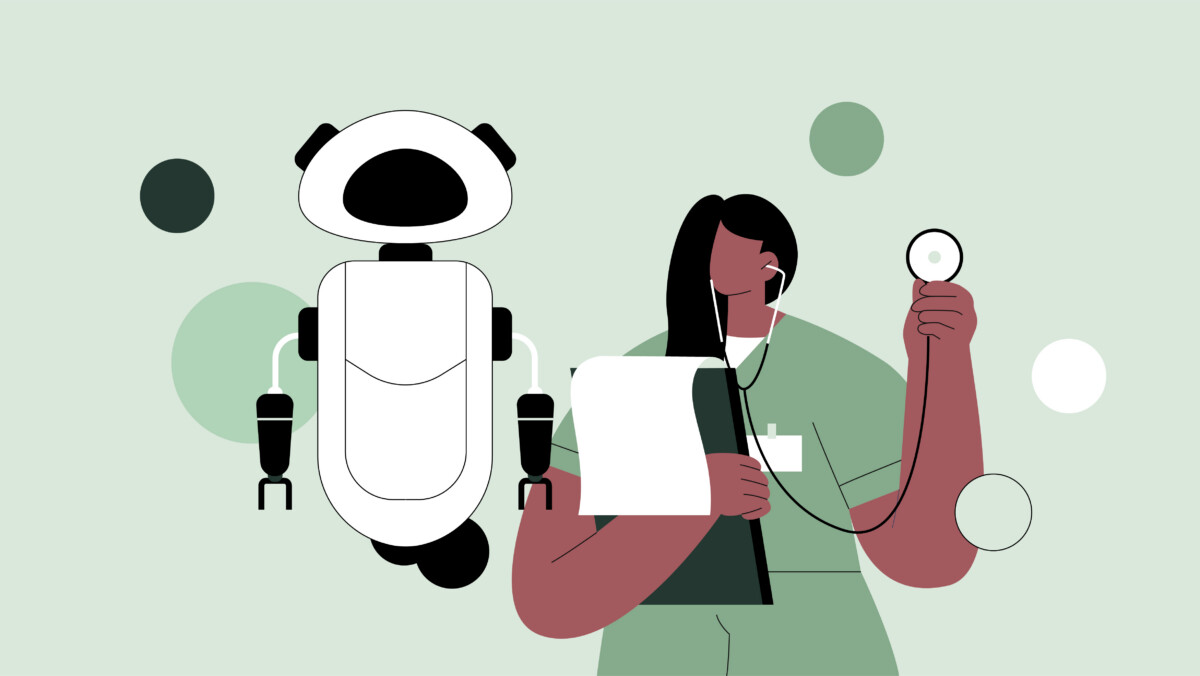
That imbalance is exactly where artificial intelligence is starting to make a difference. From ambient voice tools that draft nursing notes in real time to predictive algorithms that flag patient deterioration hours before it becomes visible, AI in nursing is moving past the hype phase and into daily workflows. The technology isn’t replacing nurses. It’s handling the repetitive, time-consuming tasks that pull them away from direct care, and giving them better data to work with when clinical decisions get complex.
When we asked nurses on Sermo how AI is showing up in their facilities, the responses ranged from genuine enthusiasm about documentation relief to honest concerns about accuracy, bias, and data privacy. Nurses and NPs across specialties are already discussing AI adoption, sharing tool reviews, and comparing what’s working at their facilities on Sermo. Join the conversation to see what your peers are saying.
The most common use cases of AI in nursing
AI tools in nursing generally fall into three categories, each targeting a different part of the clinical workflow.
Administrative automation
Tools that handle scheduling, prior authorizations, medication reconciliation, and large portions of nursing documentation are already live in major health systems. These are the repetitive, rule-based tasks AI handles well, and the ones nurses consistently say eat up the most time.
Clinical decision support systems (CDSS)
These platforms analyze large volumes of patient data, compare findings against treatment guidelines, and surface real-time recommendations. A CDSS doesn’t replace clinical judgment, but it gives nurses more information to work with, especially when they’re managing drug interactions, comorbidities, or a patient whose condition is changing quickly. A licensed practice nurse on Sermo described the value firsthand. “These systems have helped nurses make informed decisions by analyzing large amounts of data. They are invaluable because they help manage complex cases in which multiple factors must be considered.”
Predictive analytics and clinical alerts
These tools monitor vital signs, lab trends, and nursing assessments in real time, using pattern recognition to flag deterioration before it becomes clinically obvious. A predictive algorithm has the potential to flag vitals trending toward sepsis hours before traditional screening criteria would catch it, or identify when a patient is at growing risk for falls or pressure injuries based on a combination of factors. For bedside nurses, that means earlier intervention and fewer “failure to rescue” events.
Some hospitals, such as Emory Healthcare, are building AI-enabled “hubs” where a remote nurse handles admissions, discharges, and patient education via video, freeing the bedside nurse to focus on high-acuity, hands-on tasks. AI is also starting to show up in nursing education, where simulation platforms and clinical chatbots give students and working nurses a way to practice case management and sharpen assessment skills outside of live patient settings.
A surgical nurse on Sermo put it this way. “AI has huge potential to ease the administrative load that often takes nurses away from patient care. Automating tasks like prior authorizations or documentation could save so much time and reduce burnout. Still, I think the human touch in nursing, the empathy, critical thinking, and intuition, can never be replaced by AI. It should complement us, not replace us.”That said, adoption is still uneven across facilities and roles. A diabetes nurse on Sermo shared where things stand at their organization. “We use Epic as our EMR which has some inherent AI built in. It predicts a falls risk score based on the information in the chart. Some physicians are using AI to transcribe and some admins use AI to help with note taking and summaries. Nurses have not started an AI tool per se, at least not yet. Our organization does have an AI committee that determines when, where and how individuals can officially use AI within the organization.”
How AI in nursing addresses the administrative burden
The administrative burden on nurses did not get this heavy overnight. Medicare and Medicaid compliance requirements have expanded, infection control protocols introduced during the pandemic became permanent, and value-based care added layers of charting that didn’t exist a decade ago.
Voice-to-charting technology, sometimes called ambient clinical intelligence, is one of the most direct answers to the documentation problem. Nurses speak naturally during patient interactions while an AI system listens in the background and populates the EHR with structured data. The nurse is able to keep their attention on the patient instead of switching back and forth to the keyboard. A 2025 quality improvement study published in JAMA Network Open analyzed ambient AI scribes across six US health systems, finding they significantly reduced self-reported burnout from 51.9% to 38.8% after 30 days among 263 ambulatory clinicians, alongside lower cognitive task load and after-hours documentation.
An ICU nurse on Sermo described what that relief could look like in practice, “From auditing charts to making sure measures are getting met, it becomes so tedious for someone to comb through charts and waste time when AI could quickly do that and organize it in a better way. I’m a shift coordinator on my unit, and with that accomplished I could spend more time with patient interaction.”
Another surgical nurse on Sermo saw the same opportunity in a different part of the workflow. “While I personally don’t think AI could ever fully do the job of a nurse, I do think there might be use for it when it comes to more administrative tasks. Utilizing AI for prior authorizations, appeals, or letters of medical necessity could be pretty useful.”
Cutting through the noise and dealing with the shortcomings of AI in nursing
AI is not infallible, and in healthcare the failures carry real consequences. One of the most documented risks is AI hallucination, where a model generates information that sounds plausible but is flat-out wrong. A joint study by Mendel and UMass Amherst evaluated medical summaries generated by GPT-4o and Llama-3 and found serious accuracy problems in both. Out of 50 detailed medical notes, GPT-4o produced 21 summaries with outright inaccuracies, and all 50 contained overly generalized information. Llama-3 wasn’t far behind at 19 incorrect and 47 overgeneralized. In a clinical setting, that kind of inaccuracy can directly affect patient safety.
Algorithmic bias is the other major concern. If the data used to train a model reflects existing healthcare disparities, the outputs carry those same blind spots forward. Research has shown that some models systematically under-assess pain in Black patients or generate risk scores that underestimate disease severity in certain populations. For nurses, who are often the closest clinicians to the patient, recognizing when an algorithm is failing a specific patient or demographic is part of nursing ethics and patient advocacy. Knowing how to question an AI-generated score that doesn’t match what you’re seeing at the bedside is quickly becoming a core competency.
This is why the nurse’s clinical assessment has to lead the data, not follow it. AI can surface patterns, flag risks, and organize information faster than any human, but the critical thinking, empathy, and clinical judgment that define nursing are not things an algorithm can replicate.
A surgical nurse on Sermo shared an example of the shortcomings of AI. “I was involved in some AI training where I needed to complete tasks using AI. I was asked to have an AI find me the source of a common turn of phrase. It told me with certainty the phrase was from an 1800s poem. When I manually reviewed multiple of the original texts, the phrase didn’t exist in any of them. That’s not really something we can afford in some healthcare settings.”
An ICU nurse on Sermo raised a common concern. “I think AI has great use as far as screening, warning systems, and such, but I get nervous about how it might integrate into other aspects of patient care. I have trouble imagining it replacing aspects of critical thinking, experience, and intuition.”
A general nurse on Sermo kept it direct. “AI will not replace the assessment, critical thinking, and personal interactions completed by nursing and other health professionals.”
Ethical and compliance issues of AI in nursing
HIPAA was written long before generative AI tools existed, and the regulatory framework is still catching up. When nurses use AI-powered documentation tools, patient data gets processed by third-party systems, and if those systems aren’t properly configured, protected health information could end up stored, shared, or accessed in ways that violate federal privacy rules. The risk goes up considerably when nurses use consumer-grade tools like ChatGPT or Copilot on personal devices, because those platforms weren’t built to meet healthcare data security standards.
Some hospitals are addressing this by deploying enterprise-grade tools that process data within the facility’s own infrastructure, but many organizations haven’t caught up yet. Many nurses are still using AI tools informally, often without clear institutional guidance. In practice, protecting patient data when using generative AI comes down to a few non-negotiable rules. Any AI tool that touches patient information needs to be vetted and approved through the organization’s compliance process. Nurses should never enter identifiable patient details into consumer AI platforms, not even to quickly draft a care summary. Organizations handling this well tend to have dedicated AI governance committees that evaluate tools and set clear boundaries for staff.
A general nurse on Sermo framed the broader challenge. “If you are using AI as a substitute for a Google search, you are using it incorrectly. It can be a fantastic tool if you know how to use it. Whether you like it or not, it is happening. I would recommend educating yourself about it and beginning to use it or you will be left behind.”
Many nurses are trying to strike that balance. As a general nursing member on Sermo put it, “I believe AI can be a great ally if used judiciously. It can free us from administrative tasks so we can focus on what matters most, which is human care. But it is also our responsibility to ensure that technology complements, not replaces, the empathy and clinical judgment that characterize nursing.
How AI will transform nursing moving forward
The AI tools making the biggest difference right now are likely just the starting point. AI is already changing other parts of healthcare, from drug development pipelines to patient-facing tools, and nursing is at the center of many of those shifts. Several areas of technology are poised to push nursing workflows even further.
Ambient intelligence and virtual scribes
Ambient clinical voice technology is already gaining traction, and as these tools get more accurate and more tightly integrated into platforms like Epic and Cerner, voice-to-charting documentation is on track to become the default rather than a pilot program. That shift alone could fundamentally change what a typical nursing shift looks like.
Smart logistics and virtual nursing
The “virtual nurse” hub model that some hospitals are piloting is likely to become much more common as staffing pressures continue. The model also opens up new career paths for experienced nurses who want to continue practicing without the physical demands of bedside work.
Data literacy as a professional requirement
Data literacy is quickly becoming a baseline professional expectation for nurses. That means knowing what algorithmic bias looks like, recognizing when a predictive score doesn’t match the clinical picture, and being confident enough to override the algorithm based on your own assessments. Nursing programs are beginning to incorporate AI literacy into their curricula, and facilities that are adopting these tools are discovering that a one-time training module is not enough.
Key takeaways
- Nurses spend an estimated 23 to 33% of each shift on documentation and data entry rather than direct patient care.
- AI tools in nursing fall into three main categories: administrative automation, clinical decision support, and predictive analytics.
- Ambient clinical voice technology is already reducing documentation burden and clinician burnout across major health systems.
- AI hallucinations and algorithmic bias are documented risks. The nurse’s clinical assessment must always lead the data, not follow it.
- Any AI tool that touches patient information needs to clear the organization’s compliance process. Consumer-grade platforms are not safe for clinical use.
- Data literacy, including the ability to recognize bias and override flawed outputs, is becoming a core professional competency for nurses.
The bridge from data entry back to patient connection
For all the momentum behind AI adoption, the job has not changed. Nurses still assess, advocate, and build trust with patients in their most vulnerable moments. AI in 2026 is a clinical tool, no different in principle from an IV pump or a cardiac monitor. It does what it’s designed to do reliably, but it still requires a trained professional to operate it, interpret its outputs, and know when to override it.
Nurses and NPs on Sermo are leading the conversation on how AI tools are being designed, implemented, and evaluated in real clinical settings. Join the community to share your experiences, compare what is working across facilities, and connect with peers navigating the same changes.